
Buying Land and Building a House: Costly Mistakes to Avoid

Table Of Contents
Introduction: Where Most Builds Quietly Go Wrong
Why Building a Home Is Not a Checklist
Mistake One: Land Is Where Risk Actually Begins
Mistake Two: Design Is Where Cost Gets Locked In
Mistake Three: Budgets Are Decision Frameworks, Not Fixed Numbers
Mistake Four: Management Fails Without Clear Accountability
Mistake Five: Quality Requires Daily Leadership
Built for Control, Not Chaos: How J.T. Belavin Group Eliminates Costly Build Mistakes
FAQs
Introduction: Where Most Builds Quietly Go Wrong
If you are planning to buy land and build a house, you are likely about to make the largest financial commitment of your life. Most people assume the biggest risks show up during construction. That belief is wrong.
The most damaging mistakes usually happen months or even years earlier, long before excavation equipment touches the ground. They happen when confidence is built on assumptions that never get challenged.
Buying land to build a house does not fail because people are careless. It fails because the industry normalizes chaos and sells it as part of the process. The result is financial bleed, decision fatigue, and stress that homeowners never expected when they first fell in love with a property.
Here at J.T. Belavin Group, we work with homeowners who want a fully custom home without losing control of their time, money, or sanity.
What follows is a breakdown of the five most costly mistakes people make when they buy land and build a house, and why almost all of them can be avoided with disciplined planning upfront.
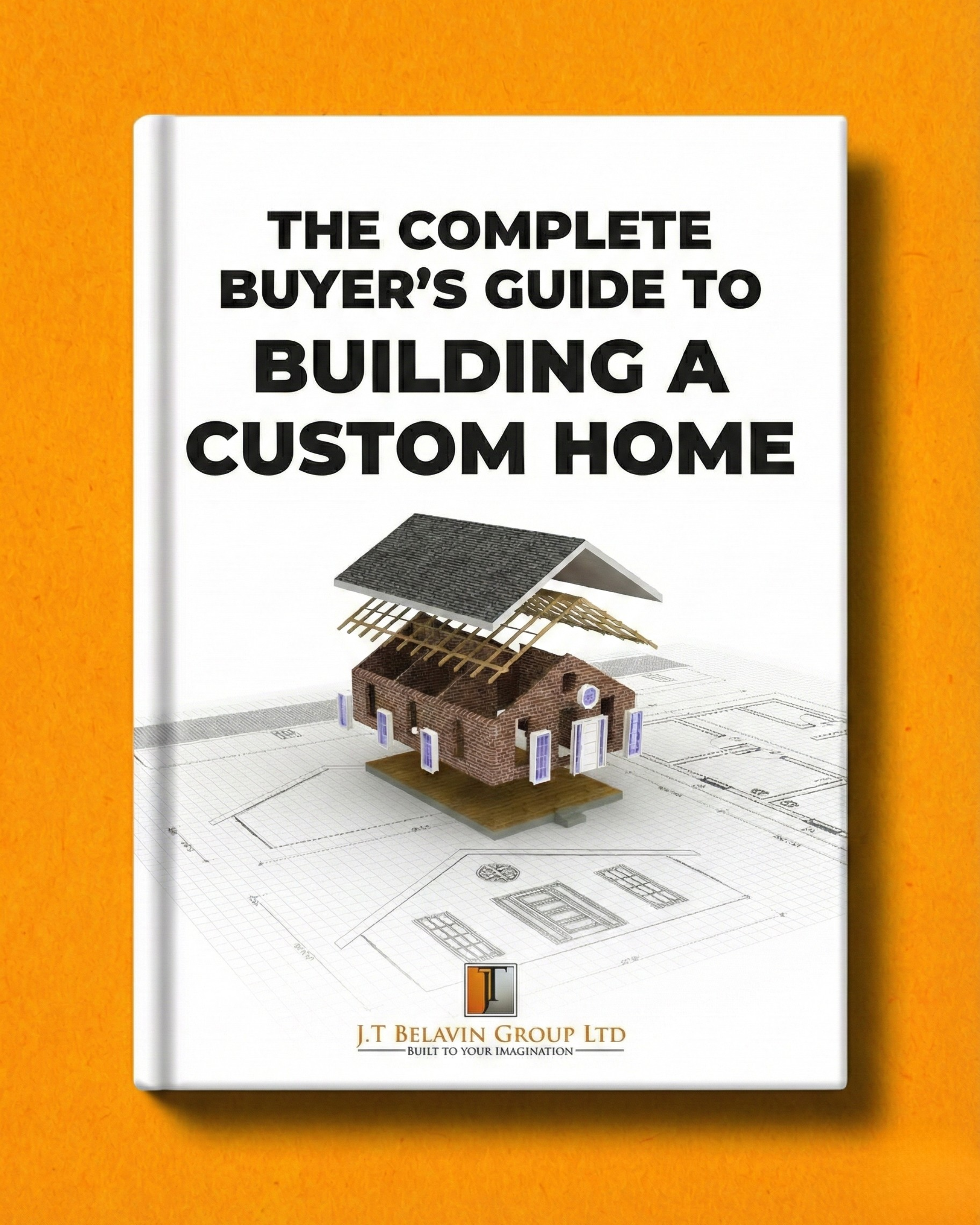
Grab Your Free Copy of:
“The Complete Buyer’s Guide to Building a Custom Home in Ontario”
Why Building a Home Is Not a Checklist
One of the most damaging beliefs in residential construction is that building a home is simply a sequence of steps. Buy land. Hire a builder. Design the house. Choose finishes. Move in.
That mental model creates chaos.
Building a home is not a checklist. It is a system. When the system is not designed intentionally at the beginning, every decision later becomes reactive. Reactive decisions are expensive decisions.
When people ask whether it is cheaper to buy land and build a house, the honest answer is that it depends entirely on how well the system is designed before emotion takes over. Cost control is not achieved during construction. It is earned during planning.

Mistake One: Land Is Where Risk Actually Begins
Land is emotional. Views, trees, privacy, and perceived potential of “what could be,” create instant attachment.
Zoning rules, setbacks, conservation restrictions, grading limitations, servicing access, and permitting realities do not care how beautiful a lot looks at sunset. They care about regulations, constraints, and physics.
One of the most expensive assumptions people make is believing that buildable means buildable the way they want. Those are two very different realities.
If you buy land before proper due diligence, you are gambling with your eyes closed. A casual conversation with a listing agent does not count. Agents sell land. They do not build on it, and they do not carry responsibility after closing.
Before buying land to build a house, every invisible constraint should be surfaced and confirmed in writing. Zoning compliance, setback requirements, grading feasibility, utility servicing, and permitting pathways must all be understood before emotion gets a vote. If clear answers are not available, that uncertainty is not reassurance. It is risk.

Mistake Two: Design Is Where Cost Gets Locked In
Most people treat design as a creative exercise. In reality, design is a financial decision framework.
By the time construction begins, most of the budget has already been locked in. Structural complexity, spans, inefficient layouts, and unnecessary architectural features all translate directly into cost. They do not show up later as abstract ideas. They show up as invoices.
The industry often separates design and construction. On paper, that sounds professional. In practice, it creates misalignment. Architects optimize for aesthetics without real time construction feedback. Builders are forced to price after decisions have already been made.
That separation is why so many homeowners experience pricing shocks after falling in love with a design.
When design and construction are integrated, decisions are informed by real world buildability and cost implications as they are made. This is how intentional control replaces reaction. This is also why the question of how to buy land and build your own house should always include who is guiding design decisions with construction reality in mind.
Mistake Three: Budgets Are Decision Frameworks, Not Fixed Numbers
Another costly mistake is treating a budget as a single number. People ask, “can I build this house for X amount of dollars?”. That question misses the point.
The real question is which decisions need to be made to stay within that price range without sacrificing what actually matters.
Vague allowances are one of the most dangerous tools in residential construction. They feel safe, but they are placeholders for future conflict with your own bank account. If you do not know exactly what is included, what is excluded, and what assumptions are being made, you do not have a budget. You have a guess.
A disciplined budget is explicit and decision driven. It shows how choices affect outcomes. Transparency does not restrict flexibility. It creates control.
This is one of the most important considerations when people ask whether it is cheaper to buy land and build a house. Cost efficiency does not come from hoping num
Mistake Four: Management Fails Without Clear Accountability
Many homeowners assume the builder handles everything. That assumption is often based on marketing language rather than reality.
In practice, homeowners frequently become the default project manager without realizing it. They answer questions under pressure, coordinate between designers and trades, and absorb risk when communication breaks down.
Poor communication is not a personality problem. It is a system problem. When no single party owns the outcome, information fragments. Delays compound. Trades reschedule. Costs increase. Stress escalates.
Complex projects do not have to feel chaotic. They only feel chaotic when accountability is unclear.
If multiple people are partially responsible, no one truly is. Identifying who owns the outcome is essential for anyone considering buying land to build a house approach.
Mistake Five: Quality Requires Daily Leadership
Most quality problems are invisible at handover. They show up years later.
Water management, insulation continuity, structural detailing, and mechanical coordination determine how a home performs. They do not photograph well, which is why they are often undervalued.
Inspections verify compliance. They do not guarantee excellence.
Quality is not achieved at the end of a project. It is enforced daily. When leadership is present and decisions are made in real time, problems are solved before they get buried. When leadership is absent, shortcuts hide behind drywall.
Long term satisfaction comes from disciplined execution, not final walkthroughs.
Built for Control, Not Chaos: How J.T. Belavin Group Eliminates Costly Build Mistakes
At J.T. Belavin Group, our process is intentionally designed to eliminate the exact failure points that derail most custom home projects.
It starts earlier than most people expect. Before land is purchased or plans are finalized, we slow the process down to pressure test assumptions around zoning, setbacks, servicing, grading, and permitting.
That upfront discipline prevents clients from buying land that quietly dictates expensive compromises later.
Design is treated as a strategic decision, not an artistic free-for-all. By integrating construction expertise into the design phase, every layout choice, structural decision, and material selection is informed by real buildability and cost impact.
This keeps pricing grounded and eliminates the shock that typically shows up after drawings are complete.
Budgeting is handled the same way. Instead of vague allowances and moving targets, we frame the budget around clear priorities and explicit scope. Clients understand how each decision affects cost in real time, which replaces guesswork with confidence.
Management is where most projects quietly unravel. Our clients are never left coordinating trades or chasing answers. There is one accountable team owning communication, schedule, and execution from start to finish.
Finally, quality is protected through daily leadership, not final inspections. Being present allows issues to be solved when they matter, not hidden until it is too late. The result is a process that feels controlled, predictable, and aligned from day one.

Ready to start your project but don’t know where to begin?
Send me a message and let’s have a chat about your vision.
Frequently Asked Questions About GTA Home/Land Buying Costs
-
It can be, but only if land constraints, design decisions, and budget tradeoffs are managed intentionally from the start.
-
Zoning confirmation, setbacks, grading feasibility, servicing access, permitting requirements, and realistic build costs.
-
Before purchasing land, so constraints and costs are understood before committing.
-
By treating the budget as a decision framework with clear inclusions, exclusions, and priorities.
-
One clearly accountable party with authority to coordinate design, trades, schedule, and quality control.